
Enrichment Ideas for Dogs: The Dachshund Owner’s Complete Guide


From DIY snuffle mats to puzzle feeders, discover the best enrichment ideas for dogs – with special tips for dachshunds, crate rest, and shelter dogs.
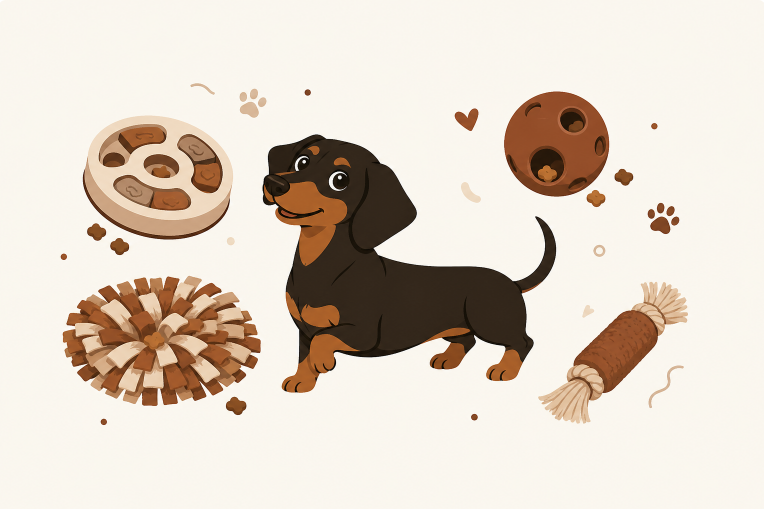
Enrichment isn’t a luxury – it’s a necessity for dogs, especially dachshunds. These little scent hounds were bred to problem-solve, and without an outlet for that drive, boredom turns into anxiety and anxiety turns into chewed furniture. The good news: enrichment doesn’t have to be complicated or expensive. Easy enrichment ideas for dogs range from frozen lick mats and DIY muffin tin puzzles to purpose-built interactive feeders. For dachshunds specifically, sniff-heavy activities and treat-dispensing toys are the sweet spot. If your dog is on crate rest, there are safe, vet-friendly options too. And if you’re looking to add the best interactive toys for dachshunds to the rotation, DachshundSpace has a dedicated collection worth browsing.
Why enrichment matters more than most owners realise
There’s a gap between a dog that’s fed, walked, and loved – and a dog that’s actually fulfilled. Enrichment is what fills it.
Canine enrichment covers any activity that stimulates your dog mentally, physically, or sensorially in a way that aligns with their natural instincts. For most dogs, that means sniffing, chewing, foraging, problem-solving, and social interaction. For dachshunds – a breed originally developed to track scent and hunt underground – it especially means nose work and independent problem-solving.
When enrichment is absent, dogs don’t just get bored. They get stressed. And stressed dachshunds have a particularly creative way of expressing that: excessive barking, accidents in the house, destructive chewing, and persistent attention-seeking are all classic signs that a doxie needs more mental stimulation, not more discipline.
The good news is that enrichment doesn’t require a PhD in animal behaviour or a large budget. It requires variety, consistency, and knowing your dog.
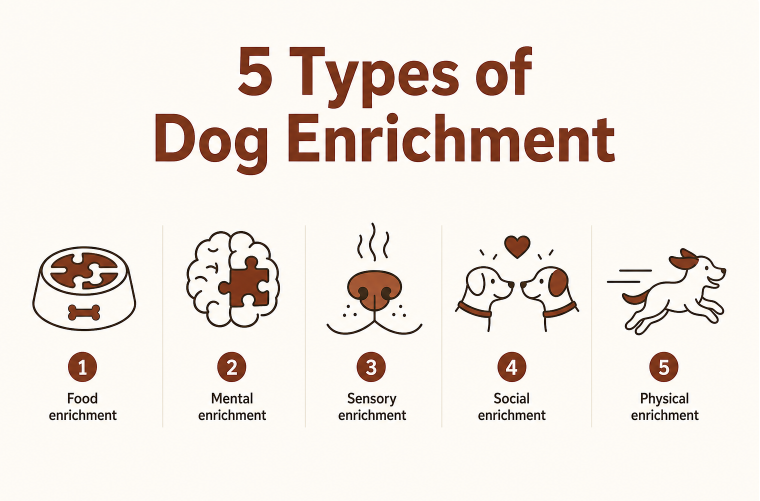
5 types of dog enrichment: food, mental, sensory, social, and physical – illustrated infographic
Easy enrichment ideas for dogs (no special equipment needed)
The simplest enrichment tools you have are already in your kitchen.
Muffin tin puzzle. Place a small handful of kibble or treats in each cup of a muffin tin, then cover each cup with a tennis ball. Your dog has to figure out that the balls are obstacles, not prizes. Most dogs solve it within a few tries – then you can up the difficulty by covering only some cups and leaving others empty.
Towel roll. Spread a hand towel flat, scatter treats across it, and roll it up tightly. Let your dog unroll it. It takes most dogs several satisfying minutes.
Cardboard box dig. Fill a cardboard box with crumpled paper, old rags, and hidden treats. Let your dog dig, sniff, and destroy. Messy, but remarkably tiring.
Scatter feeding. Instead of feeding from a bowl, scatter your dog’s entire meal across the grass (or a snuffle mat indoors). For dachshunds, this is genuinely exhausting – their noses go into full drive mode and a 10-minute scatter feed can be as tiring as a longer walk.
Ice block treats. Pour low-sodium broth or plain water with fruit into a container, add treats, freeze overnight. Give as a lick-and-chew puzzle. Works particularly well in summer.
These are genuinely the best easy enrichment ideas for dogs when you need something fast and free.
DIY enrichment ideas for dogs on a budget
If you want to go a step further without spending much, there are a handful of DIY enrichment ideas for dogs that genuinely deliver.
Snuffle mat. A snuffle mat is a rubber mat with fabric strips tied through holes in a grid pattern – treats get hidden in the fabric and the dog uses their nose to find them. You can buy them, but they’re also one of the easier dog projects to make yourself. All you need is a rubber sink mat with holes, fleece fabric cut into strips, and about an hour. The result is reusable for years.
Frozen Kong or lick mat. A Kong stuffed with peanut butter, mashed banana, or wet food and then frozen solid can occupy a motivated dog for 30-45 minutes. Lick mats work on the same principle – spreading a thin layer of food across a textured surface and freezing it turns a 2-minute meal into a 20-minute enrichment session.
Scent work with cups. Set out three or four cups upside down, hide a treat under one, and shuffle. Start slow, reward generously, and increase difficulty as your dog gets the idea. This is the home version of professional nose work and some dogs become genuinely obsessed with it.
Paper bag crinkle toy. Fold the ends of a paper bag, put a few treats inside, and hand it over. Dachshunds in particular enjoy the noise, the smell, and the challenge of getting inside.
Dog enrichment ideas for shelters
Shelter dogs face a specific challenge: they’re in an unfamiliar, often stressful environment with limited human contact and very little to do. Dog enrichment ideas for shelters are a genuine welfare intervention – not just a nice extra.
The most effective shelter enrichment strategies focus on:
Sensory rotation. Introduce new scents regularly – a used dog toy from a foster home, dried herbs in a sock, a smear of peanut butter on the kennel wall at nose height. Novelty keeps the brain engaged.
Puzzle feeders instead of bowls. Feeding from a puzzle toy adds 15-20 minutes of active engagement to every meal. For shelters with limited staff time, this is one of the best returns per minute of investment.
Chew rotation. Different textures – rubber, rope, rawhide-free alternatives, stuffed fabric – prevent habituation. A dog that’s bored of one chew will still engage with a new one.
Short training sessions. Even 5 minutes of basic recall or sit practice gives a shelter dog something to focus on and a human connection to build on.
Calming enrichment. Lick mats and frozen Kongs also work well in kennel environments because they encourage the naturally calming behaviour of licking, which can lower stress hormones in anxious dogs.
Enrichment ideas for dachshunds specifically
Dachshunds are not just small dogs. They’re a working breed with a very specific set of drives, and enrichment that works for a Labrador won’t always work for a doxie.
A few things that make dachshund enrichment different:
Their noses are their superpower. Dachshunds have approximately 125 million scent receptors – 40 times more than humans. Any enrichment that involves tracking a scent is going to be deeply satisfying in a way that visual toys simply aren’t. Scatter feeding, snuffle mats, and scent work puzzles should be the backbone of enrichment ideas for dachshunds.
They have strong independent problem-solving instincts. Bred to hunt alone underground, dachshunds are comfortable working through a challenge without looking to you for the answer. This is why puzzle feeders suit them so well – they don’t give up as quickly as some breeds.
Their backs need protecting. Dachshunds are predisposed to intervertebral disc disease (IVDD), which means enrichment that involves jumping, running on hard surfaces, or twisting through tight spaces should be approached with care. Low-impact, floor-level activities are generally best.
They’re stubborn in the best way. Give a dachshund a puzzle that’s too easy and they’ll solve it once and walk away. You need a toy with genuine difficulty or the ability to increase the challenge over time.
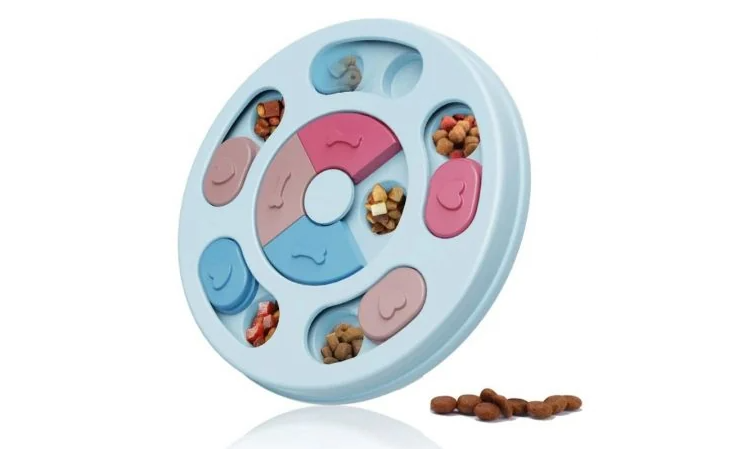
Interactive dachshund feeding toy – one of the best enrichment products for dachshunds, from DachshundSpace
How to keep a dachshund occupied: a practical daily routine
The most common question dachshund owners ask is some version of: how do I keep a dachshund occupied for longer than 10 minutes at a time?
The answer is rotation and difficulty progression.
A good daily enrichment routine for a dachshund might look like this:
Morning: Scatter feed breakfast on a snuffle mat or in the grass. Takes 10-15 minutes and starts the day with a satisfying sniff session.
Midday: Offer a frozen lick mat or stuffed chew toy while you’re busy with work. Low intensity, calming, and keeps the boredom from building.
Afternoon: A short scent work session (hide 3-4 treats around a room and release your dog to find them), or 5-10 minutes of basic training using high-value treats. Mental effort here.
Evening: A puzzle feeder for dinner instead of a bowl, followed by a chew to wind down.
Rotating through different types of enrichment – sensory, food-based, problem-solving, physical – keeps every session feeling novel. If you always do the same thing, even a good enrichment toy stops being interesting after a week.
What actually happened when I left my dachshund home alone
I’ll be honest – the first time I left my dachshund home alone for a full workday, I came back to a chewed corner of the sofa and a very pleased-looking dog. No guilt whatsoever. Just tail wags and that signature dachshund expression that says “I don’t know what you’re talking about.”
That was the moment I realised I hadn’t set her up for success. I’d left her with water, a bed, and a basic rope toy. For a breed that was literally built to hunt alone in underground tunnels for hours, that’s approximately zero stimulation.
The next time I had a long day out, I did things differently. The night before, I stuffed Kong with a mix of wet food and peanut butter and put it in the freezer. In the morning, before I left, I scattered her breakfast across a snuffle mat instead of putting it in her bowl. I also left the Dachshund IQ Feeder loaded with a handful of kibble in the middle of the living room floor, and tucked a few small treats under the edges of a folded blanket.
I set up a camera to check in on her. What I saw: she spent the first 40 minutes working through the snuffle mat, pausing regularly to look very satisfied with herself. Then she found the Kong – which, frozen, kept her busy for another 20-25 minutes. The IQ feeder got solved in stages. By mid-morning, she was napping.
No chewed sofa. No barking. Just a genuinely tired, content dog.
The difference wasn’t the cost of the toys – a frozen Kong and a scatter feed are basically free. It was the preparation and the variety. She had something to find, something to chew, something to solve. That’s all a dachshund really needs.
Enrichment ideas for dogs on crate rest
Crate rest is one of the trickiest enrichment challenges – especially for dachshunds, who are predisposed to spinal issues that sometimes require extended recovery periods.
The goal for enrichment ideas for dogs on crate rest is to provide mental stimulation without physical exertion. That rules out anything involving jumping, fetch, tug, or sustained running.
What does work:
Lick mats and frozen Kongs. These are the crate rest gold standard. Stationary, calming, and genuinely engaging. Freeze them the night before for longer-lasting occupation.
Calm puzzle feeders. A simple treat-dispensing toy that rolls around slowly on the crate floor is fine. Avoid anything that requires active pushing or vigorous movement.
Chew toys. Appropriate chews (always vet-approved during recovery) give a dog something to do with pent-up energy without requiring any physical exertion.
Sniff games in the crate. Place a few small treats at different spots in the crate bedding and let your dog sniff them out. Keeps the nose busy without the body working.
Calm audiovisual enrichment. Some dogs genuinely respond to dog-specific TV or relaxation audio during crate rest. It won’t replace other enrichment, but it fills the quiet.
Always check with your vet about appropriate enrichment levels during any recovery period – what’s right depends entirely on what your dog is recovering from.
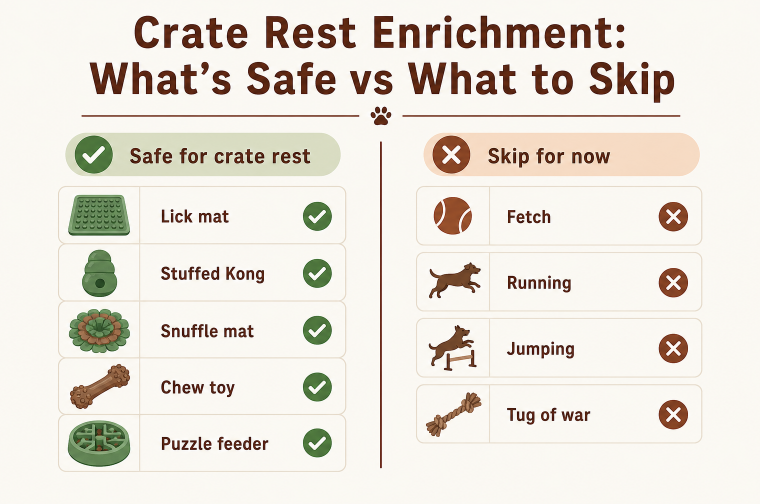
Crate rest enrichment: what’s safe vs what to skip – illustrated guide
Best interactive toys for dachshunds
Purpose-built enrichment toys are worth the investment for dachshunds because DIY options, while effective, don’t always match the difficulty level a problem-solving-oriented dog needs.
Here are the interactive toys for dachshunds that consistently get the best results:
Dachshund IQ Feeder Toy – $24.95 (currently 17% off)The best all-rounder. Fill it with kibble or small treats and your dachshund has to work out how to release the food. It’s rated 4.80/5 by buyers, and the reviews consistently mention how well it holds a dachshund’s attention compared to simpler toys. Doubles as a slow feeder for dogs who eat too fast.
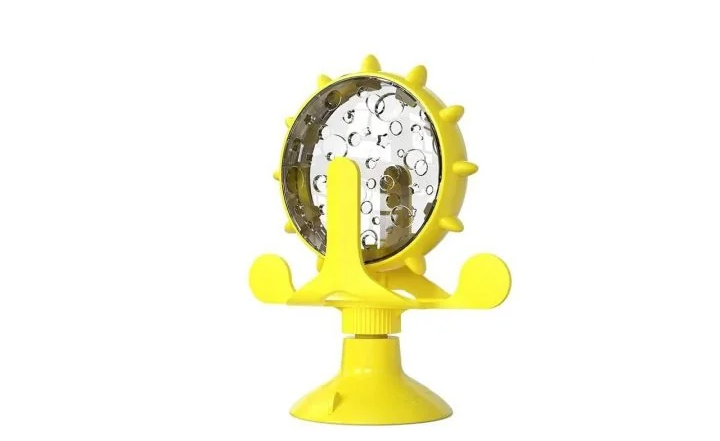
Dachshund IQ Feeder Toy – rated 4.80/5, one of the best interactive toys for dachshunds, as taken from DachshundSpace
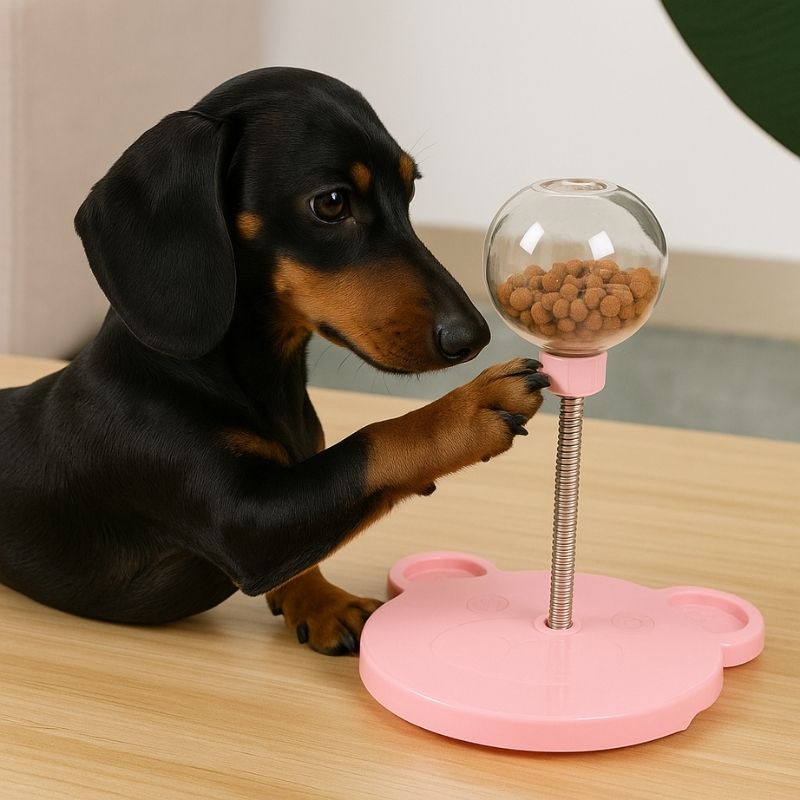
Interactive Dachshund Feeding Toy – $39.95 (currently 20% off)A more involved puzzle that challenges your dog through multiple stages of interaction. Good for dogs who have already mastered simpler feeders and need an upgrade in difficulty.
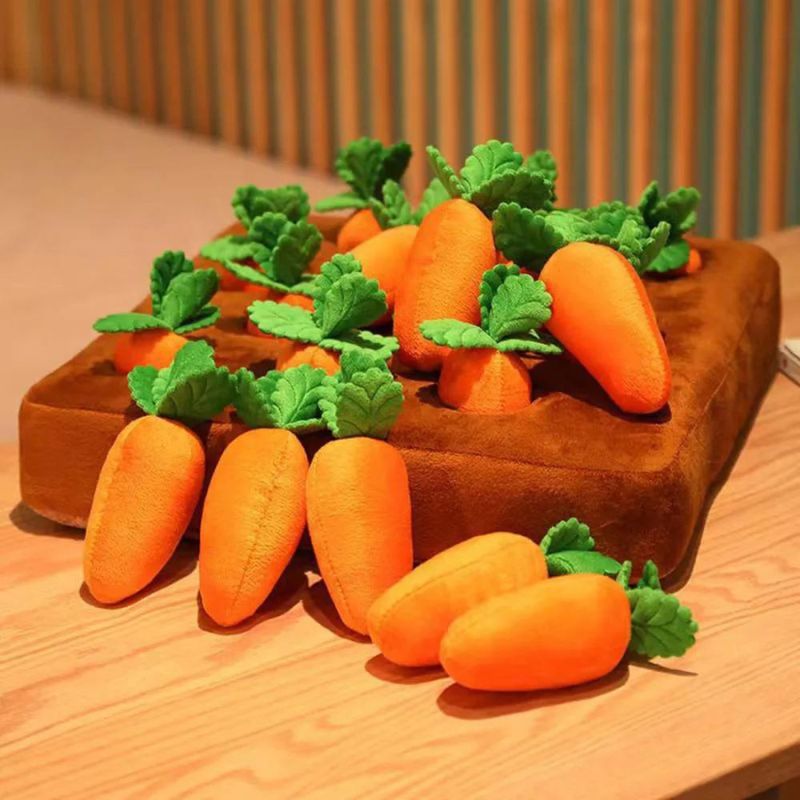
Carrot Plush Interactive Dachshund Toy – from $39.95A softer enrichment option – this one satisfies the prey-drive aspect of play rather than the food-seeking aspect. Rated 4.67/5. Works well for dachshunds who are more toy-motivated than food-motivated, or as an alternative during crate rest cool-down periods.
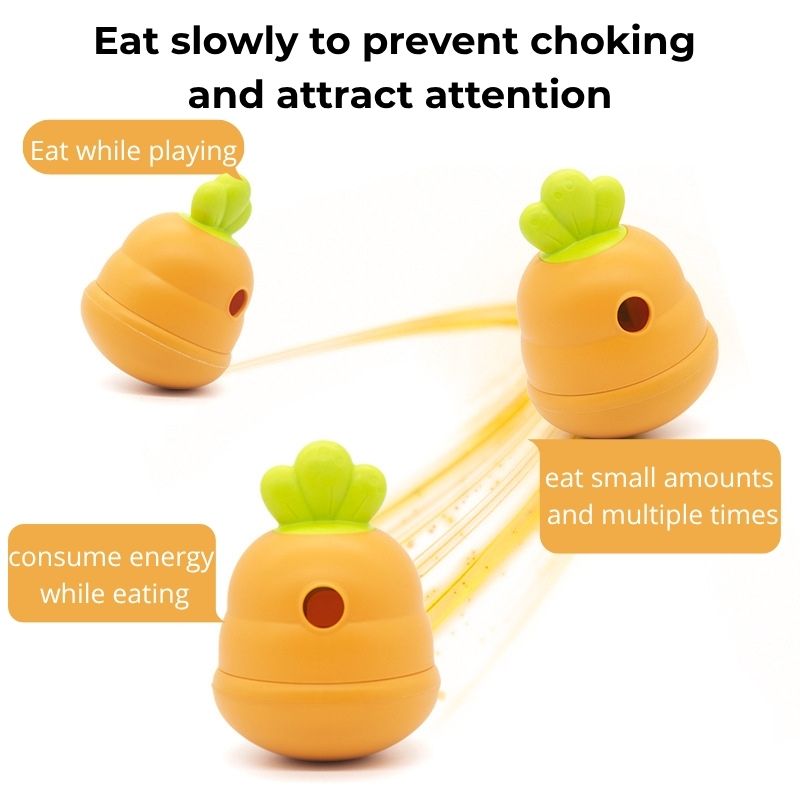
Carrot Tumbler Doxie Food Toy – $59.95 (25% off from $79.95)A carrot-shaped wobble/tumbler toy – your dog nudges it and food falls out. The unpredictable motion makes it more engaging than a static feeder. Good for independent play when you can’t supervise.
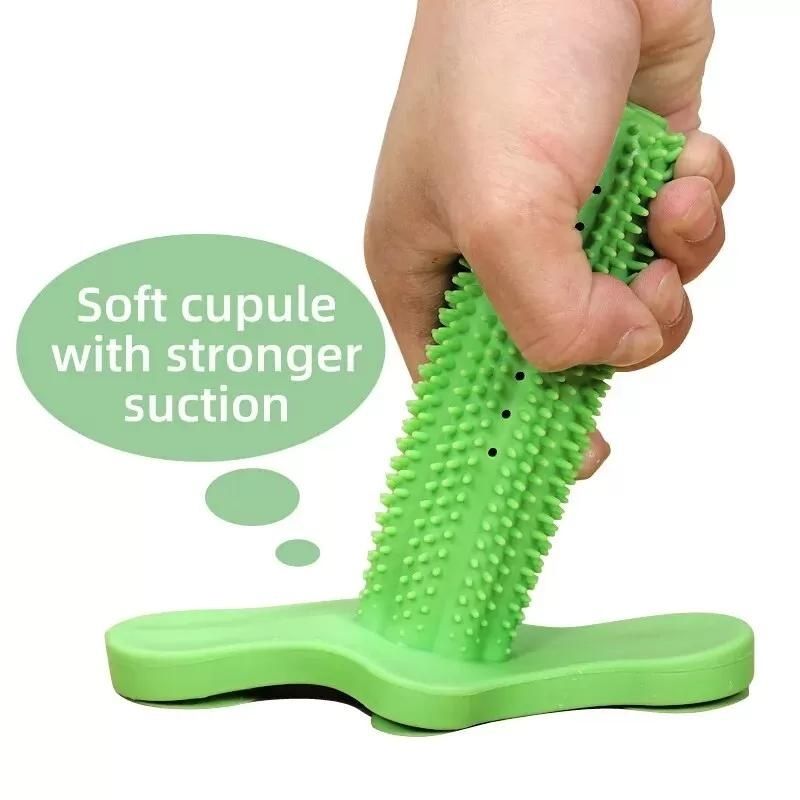
Doxie Cactus Interactive Chew Toy – $29.95Best for dogs who need to chew as much as puzzle-solve. Combines the satisfying texture of a chew toy with an interactive element.
Browse the full collection at DachshundSpace toys – they specialize in toys designed around dachshund body proportions and behavioral instincts, which makes a genuine difference versus generic pet store options.
Building a sustainable enrichment habit
The biggest mistake dog owners make with enrichment is treating it as a one-off solution rather than an ongoing habit. Buying a puzzle toy, using it three times, and then forgetting about it doesn’t do much.
What actually works is building enrichment into the daily routine in a way that doesn’t feel like extra work:
- Keep 4-6 toys in rotation rather than offering all of them at once. Novelty is a big part of what makes enrichment engaging.
- Use meal times as enrichment time – your dog is getting fed anyway, so the only cost is switching from a bowl to a feeder.
- Match the enrichment to your dog’s energy level. A post-walk, tired dachshund needs a calm lick mat. A freshly rested, bouncy one needs a challenging puzzle feeder.
- Increase difficulty over time. Start easy so your dog builds confidence, then make it harder as they get the hang of it. Most good puzzle toys have adjustable difficulty.
- Watch for boredom signals. If your dachshund sniffs a toy once and walks away, it’s either too easy, they’re not hungry enough, or they’ve had it too many times in a row. Rotate, refresh, and re-engage.
DIY enrichment ideas you can make today – illustrated guide with 4 easy options
Try DachshundSpace
DachshundSpace started as a community for dachshund lovers and has grown into a full shop built around what dachshunds actually need – toys sized for their proportions, designed for their instincts, and tested by real doxie owners. Our interactive toy collection is particularly strong for enrichment-focused owners, with puzzle feeders, tumbler toys, and interactive plush options at competitive prices. Regularly discounted and backed by 10,000+ five-star reviews.
Enrichment ideas for dogs don’t need to be complicated. The most effective approach is a consistent daily rotation of food-based, sensory, and problem-solving activities – snuffle mats, scatter feeding, lick mats, and puzzle feeders cover most of what your dog needs. For dachshunds specifically, nose-forward enrichment is the most satisfying because it plays to their hunting instincts. If your dog is on crate rest, frozen Kongs and calm chew toys are your best friends. And when it’s time to bring in a purpose-built toy, the interactive toy range at DachshundSpace is worth a look – they’re designed specifically for dachshund bodies and brains.
Frequently Asked Questions
What are the best enrichment ideas for dogs at home?
The most effective enrichment ideas for dogs at home include puzzle feeders, lick mats, snuffle mats, stuffed Kongs, and DIY muffin tin games. For dachshunds, puzzle feeder toys and interactive plush toys work especially well because they satisfy both the hunting instinct and the need for mental stimulation.
How do I keep my dachshund occupied when I’m busy?
To keep a dachshund occupied, offer a rotation of interactive toys so nothing feels stale – a treat-dispensing feeder one day, a frozen lick mat the next, a tumbler food toy the day after. Scent work is another reliable option: hide treats around a room and let your doxie sniff them out – it tires them out faster than a walk.
What enrichment can a dog do on crate rest?
For enrichment ideas for dogs on crate rest, stick to calm, stationary activities that don’t involve jumping or twisting: lick mats spread with peanut butter or wet food, frozen Kongs, chew toys, and quiet puzzle feeders. Always check with your vet before introducing any activity during recovery.
Are interactive toys worth it for dachshunds?
Absolutely. Dachshunds were bred to hunt independently, which means they have a strong problem-solving drive. Interactive toys for dachshunds tap into that instinct and help prevent boredom, anxiety, and the destructive behaviors that come with them. The Dachshund IQ Feeder Toy is rated 4.80/5 by verified buyers and is one of the most popular options for exactly this reason.
Can I make DIY enrichment ideas for my dog?
Yes – many of the best DIY enrichment ideas for dogs cost almost nothing. A muffin tin with kibble and tennis balls on top, a cardboard box stuffed with crumpled paper and hidden treats, or a towel rolled up with food inside all make great puzzles. You can mix these with a purpose-built toy like the Dachshund IQ Feeder to keep things varied and interesting.





 Dachshund Jackets & Coats
 Dachshund Hoodies
 Dachshund Sweaters
 Dachshund Shirts
 Dachshund Life Jackets
 Dachshund Costumes
 Dachshund Pajamas

 Dachshund Harnesses
 Dachshund Collars


 Dachshund Backpacks


