

How to Stop a Dachshund Escaping Its Harness? What Type of Harness To Choose?


Dachshunds are natural escape artists. Learn why they slip out of harnesses, how to fit one properly, and which step-in harnesses work best for your wiener dog.
Dachshunds escape harnesses because their barrel chest and narrow waist create a natural funnel – most harnesses slide straight off when they pull backwards. The fix is two-pronged: get the fit right (snug at the chest, no gaps), and switch to a step-in harness that wraps the torso from below rather than slipping over the head. A little desensitization training helps too, especially for nervous dogs who actively work to escape.
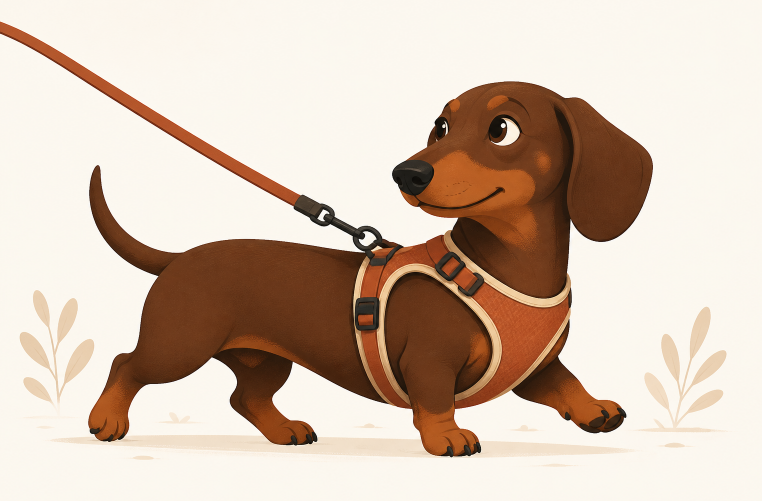
You’re halfway through a walk, your dachshund plants their feet, and by the time you turn around – the leash is limp, the harness is on the pavement, and your dog is looking at you with an expression that says you were never in charge.
Sound familiar? You’re not alone. Dachshunds are genuinely one of the hardest breeds to keep in a harness, and it’s not just stubbornness (though that’s part of it). Their bodies are built in a way that makes most standard harnesses a poor fit. The good news: once you understand why it happens, fixing it is surprisingly straightforward.
I learned this the hard way with my own dachshund, Frankie. He was two years old when I took him to a farmer’s market for the first time – busy, noisy, lots of other dogs. He handled it fine for about ten minutes. Then a kid dropped a metal tray nearby and the crash sent Frankie into a full panic. Before I could react, he had reversed himself clean out of the H-harness I’d been using for months and bolted. I caught him three stalls down, tail between his legs, pressed against a cheese vendor’s table. My hands were shaking for an hour.
That afternoon I went home and actually looked up why it had happened. I’d been using the wrong harness style entirely – the over-the-head kind, with one belly strap. For a dog shaped like Frankie, that’s basically an invitation. His chest is wider than his waist by a wide margin, and once he was moving backwards with enough force, the harness just… slid off. No resistance at all.
After that I tried four different harnesses over the next few weeks. A step-in was the one that finally stuck – literally. He’s tried to back out of it twice and failed both times. I’ve been using one ever since.
Why dachshunds are so good at escaping harnesses
Most dog harnesses are designed around a dog with a fairly uniform body width from chest to hips. Dachshunds are the opposite of that.
They have a wide, deep barrel chest, a narrow waist, and short legs set low to the ground – the product of centuries of selective breeding for hunting badgers underground. That body shape is adorable, but it’s also a structural problem for standard harnesses.
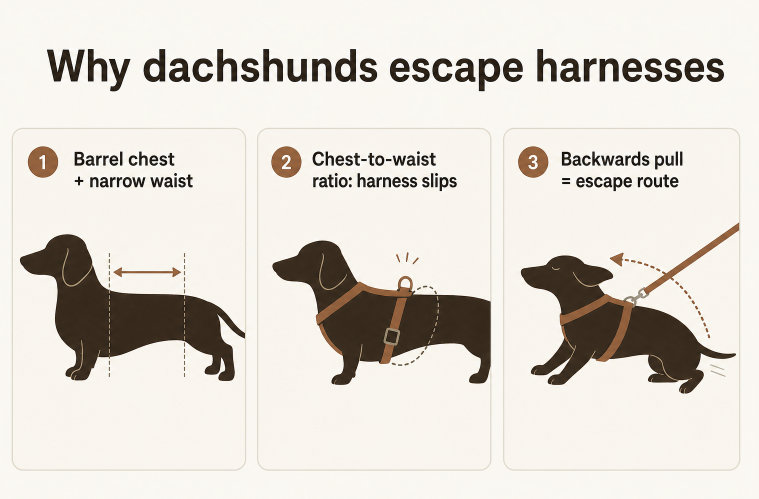
Why dachshunds escape harnesses: barrel chest, narrow waist, and backwards pull mechanics, as shown by the Dachshund Space team.
Here’s the physics: a traditional H-style harness – the kind with a chest loop and a belly strap – sits snugly at the widest point of the chest. But when a dachshund pulls backwards (which they do the moment they decide the walk is over), the harness moves toward the narrower waist. At that point, there’s nothing to stop it sliding over the hips. The dog backs out clean.
There’s also a temperament factor. Dachshunds were bred to work independently and to think for themselves. They’re not naturally inclined to defer to leash pressure – when they hit resistance, their first instinct is often to push back against it, not yield to it. That makes the backing-out problem worse, because the dog is actively working at it rather than accidentally stumbling free.
And fear plays a role too. A dachshund that’s nervous on walks – spooked by traffic, another dog, a loud noise – will often panic and pull backwards hard. That’s the moment most escape attempts happen. If the harness isn’t fitted for that kind of pressure, the dog gets out.
The two-finger rule: getting the fit right first
Before you look at switching harnesses, check the fit of the one you have. A surprising number of dachshund harness escapes come down to incorrect sizing rather than the wrong style entirely.
The basic test: with the harness fastened, try to slip two fingers under each strap. You should be able to – but barely. If you can fit three fingers, or if the harness can be shifted side to side easily, it’s too loose.
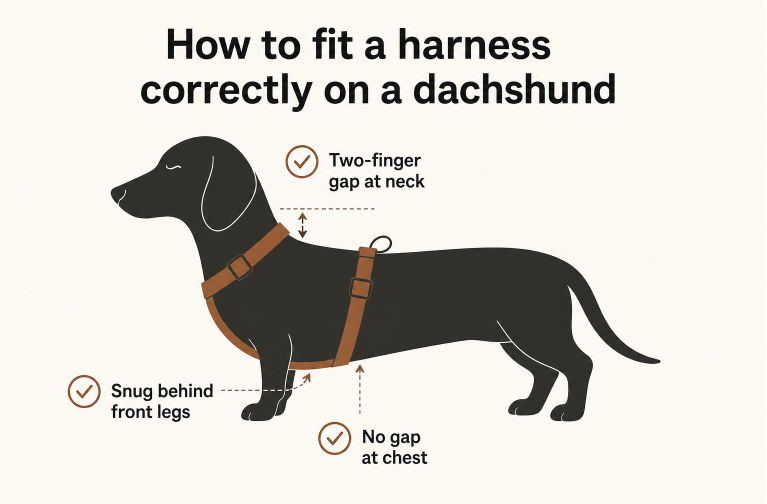
How to fit a dachshund harness correctly: two-finger gap, snug behind front legs, no gap at chest, as illustrated by our Dachshund Space team
Check these three points specifically:
- The chest panel should sit flat against the sternum without gapping. If you can pinch fabric away from the chest, it’s too loose here.
- Behind the front legs is where most harnesses fail on dachshunds. This strap needs to be genuinely snug – not cutting in, but not shifting when the dog moves.
- The back clip point should sit roughly in the middle of the back, not slipping toward the neck or the tail.
Dachshunds also change shape more than most breeds as they age or if their weight fluctuates. Measure your dog every few months and re-check the adjustment settings – a harness that fitted well six months ago may have become a loose one.
A key rule: never fit the harness so tight it causes discomfort, but never leave it loose enough that it can travel backwards over the hips.
Tips and tricks to stop the great escape
Getting the fit right is step one. Here’s what to layer on top of it.
Switch to a step-in style
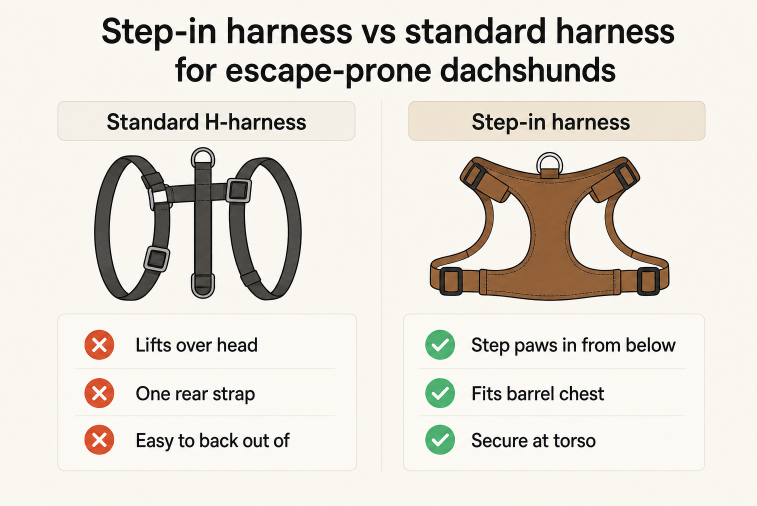
Standard H-harnesses and vest harnesses that go over the head are the most commonly escaped. A step-in harness works differently: the dog places their front feet into two loops, and the harness is then clipped at the back. Because the attachment point distributes around the torso rather than just sitting over the top, it’s much harder for a dachshund to back out of.
Step-in harness vs standard H-harness for dachshunds: why step-in designs prevent backing out, as illustrated by Dachshund Space
Look for multiple adjustment points
More adjustment points means a more precise fit, which means less room for the harness to shift. Look for harnesses with at least two – ideally three – adjustable straps. A single loop that tightens around the girth might fit a standard-shaped dog fine but will leave gaps on a dachshund’s narrowing waist.
Use metal hardware, not plastic
This sounds like a small thing until a buckle fails mid-walk. Plastic buckles on budget harnesses are notorious for popping open when a dog pulls hard. Metal D-rings and metal buckles take significantly more force to open accidentally. For a determined dachshund, this matters.
Double-clip on busy walks
If your dog has a history of escaping, use a double-ended leash that clips to both the harness and a well-fitted collar. If one gives way, the other holds. This is particularly useful in high-distraction environments (city streets, off-leash dog areas) where a bolting dog is genuinely dangerous.
Desensitize before you walk
This is the most skipped step, and it’s the one that makes everything else work better. A dachshund that tolerates the harness calmly is far less likely to panic-back out of it than one that treats every walk prep like a wrestling match.
The process:
- Leave the harness on the floor near your dog’s bed for a few days. Let them sniff it. Treat it as completely boring.
- Drape it over their back without fastening. Treat. Remove. Repeat.
- Fasten it for 30 seconds indoors. Treat heavily. Unfasten.
- Build to short indoor walks, then outdoor ones.
The whole process takes a week or two. It’s worth every minute, because a dog that associates the harness with good things will actively cooperate with being harnessed rather than trying to get out of it.
Check the fit after every wash
Nylon harnesses – which are most of the good ones – stretch slightly after washing and can shrink slightly when drying on heat. A harness that fitted on Monday after washing it on Sunday might be marginally looser. Get in the habit of running the two-finger check before every walk, not just when you buy it.
The best harnesses for dachshunds who escape
Not all harnesses are created equal for this breed. Here’s what to look for – and some specific picks that work well.
What to look for in an escape-proof dachshund harness
The key features for a dachshund who escapes:
- Step-in design – front legs step into loops, clip at the back. Harder to back out of than over-the-head styles.
- Chest-forward fit – the harness should sit against the sternum, not sit behind the front legs.
- Minimum two rear straps, or a wide back panel – more contact area means less room to wriggle out.
- Metal buckles and D-rings – for durability under real pulling pressure.
- Multiple adjustment points – the narrowing dachshund waist needs fine-tuning.
Step-in harnesses from Dachshund Space
Our brand, Dachshund Space, stocks a range of step-in harnesses specifically designed for the dachshund body shape. A few worth looking at:
Pawcci Bee Harness & Leash Set – a step-in design in nylon with metal leash rings, adjustable across XS to L sizing, and comes with a 160cm leash. Smooth, skin-friendly straps that won’t cause chafing behind the front legs – an important detail for a breed with tight elbow clearance. Currently priced at $44.95.
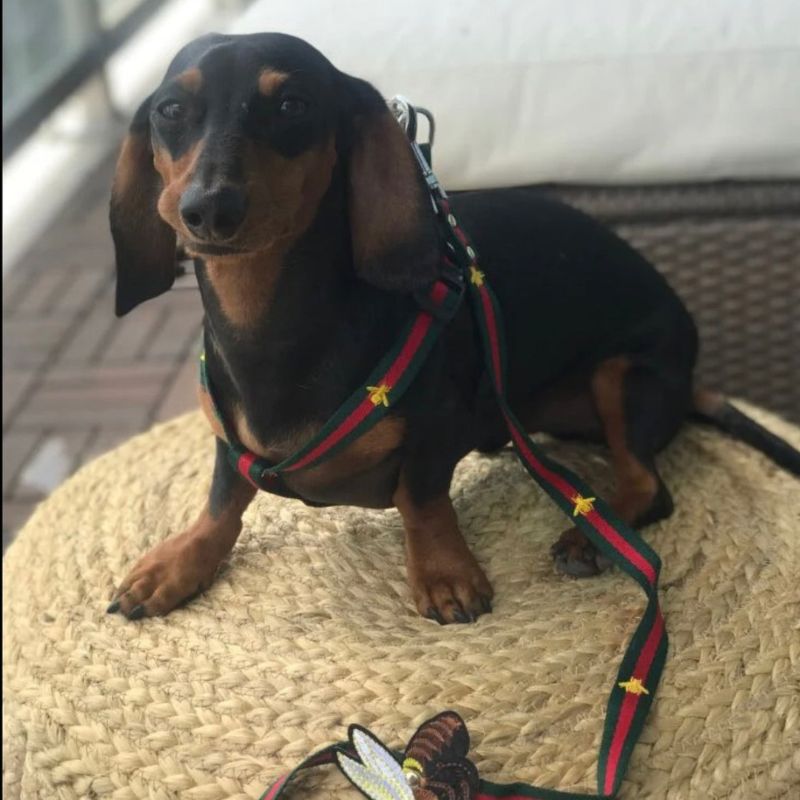
Pawcci Harness & Leash – adjustable straps, breathable lightweight material, and a matching leash. Designed specifically for the dachshund build with the chest-forward fit that matters for preventing backwards escapes.
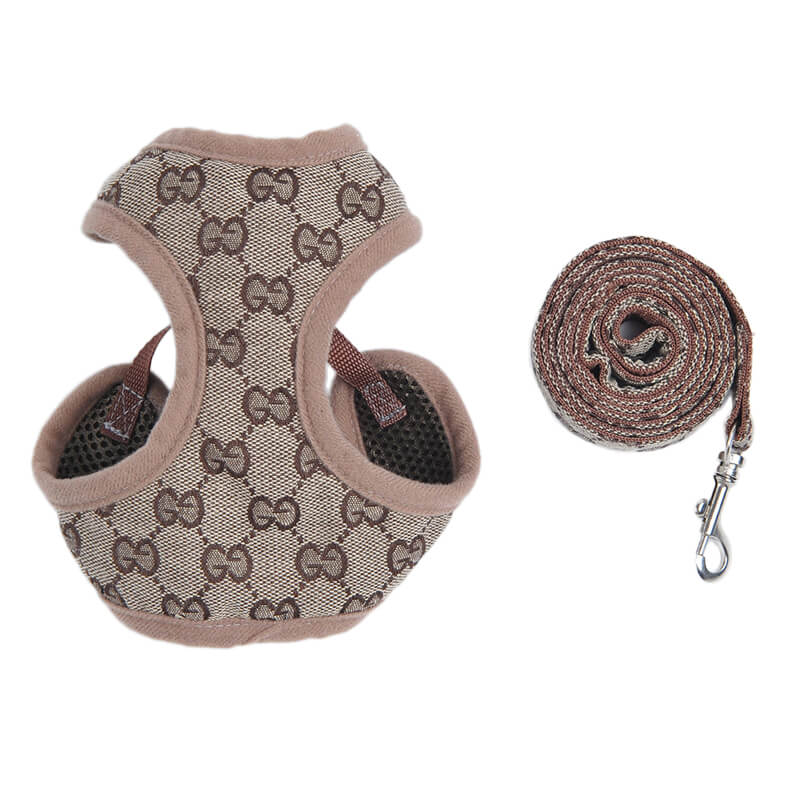
Doxie Reflective Harness & Leash – a practical option if you walk in low-light conditions. Reflective panels plus a soft, breathable texture that reduces neck pulling. Good for dogs who are still building leash confidence.
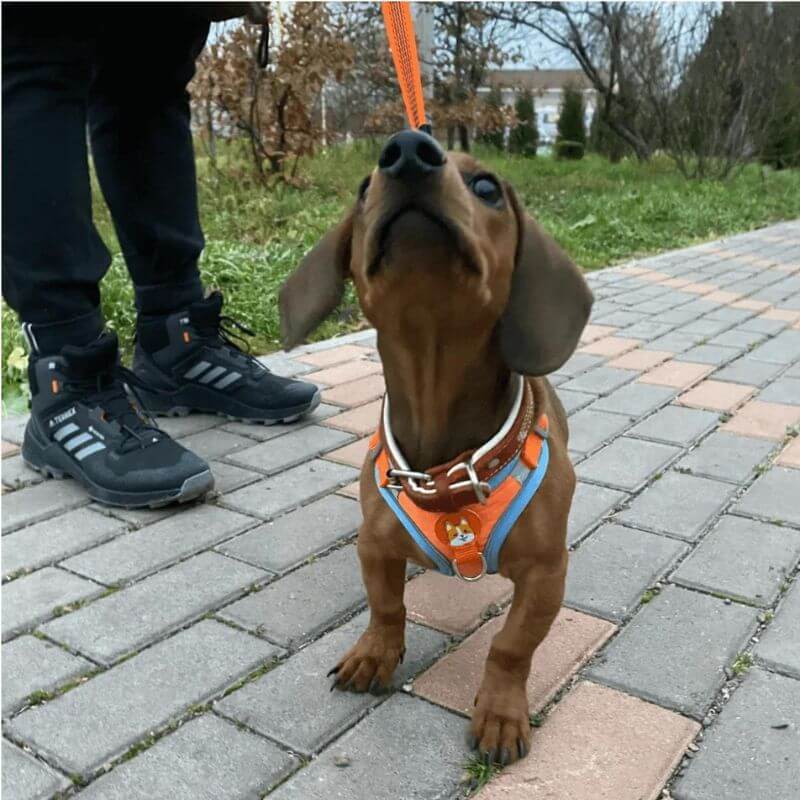
Colorful Dachshund Space Harness – available in multiple colors from $27.95, with adjustable fit and dachshund-specific sizing.
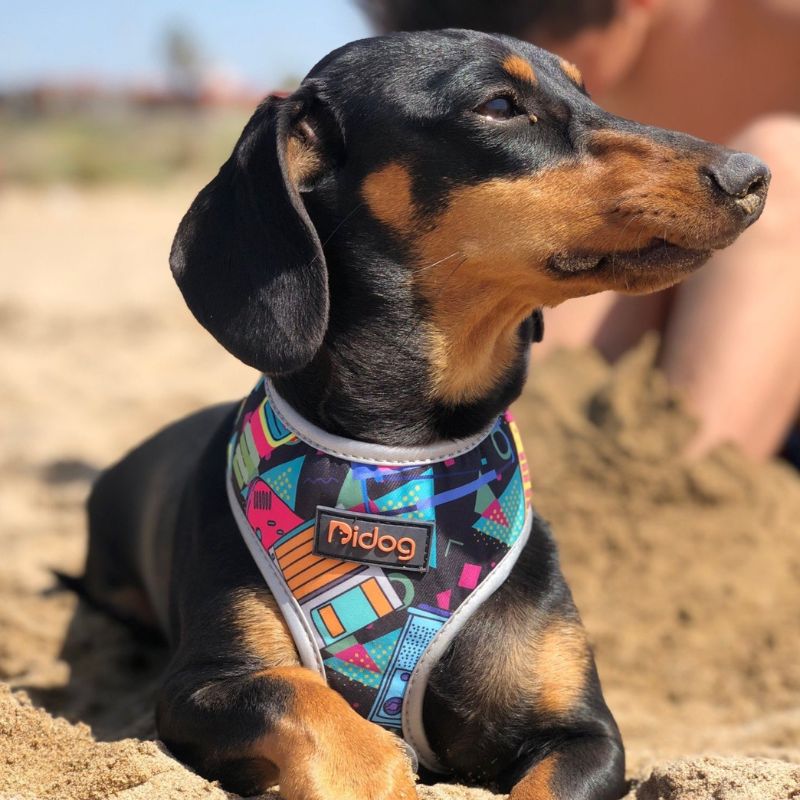
All of these come in sizes calibrated for miniature and standard dachshunds separately – not generic dog sizing, which almost always runs too wide at the belly for a wiener dog.
What to avoid
No-pull harnesses (front-clip only) – these are designed to redirect a forward-pulling dog. They’re not designed for a dachshund backing away from you, and can actually make it easier to escape if pulled backwards.
Wide chest plate designs – if the chest strap or plate is very wide, it may sit across the inner leg and cause chafing. Dachshunds’ short legs leave very little clearance.
Single-strap belly bands – a harness with just one belly strap has too little contact area to hold against a determined backing dachshund.
A note on why you shouldn’t just switch to a collar
The temptation when a dog keeps escaping their harness is to go back to basics and try a collar. For most breeds that’s a reasonable backup – for dachshunds, it’s genuinely not a good idea.
Dachshunds have the highest rate of intervertebral disc disease (IVDD) of any breed, with around 25% developing a disc problem in their lifetime. A collar concentrates all leash pressure directly on the cervical spine. A harness spreads that same force across the shoulders and chest. For a breed already carrying significant spinal risk, a collar turns every reactive lunge into a potential injury event.
The right answer to the escaping problem is a better-fitting harness – not a collar.
Try Dachshund Space harnesses
Dachshund Space stocks 20+ harness styles sized specifically for dachshunds – miniature and standard – with step-in designs that work with the breed’s unusual body shape rather than against it. Their harness and collar range covers everything from everyday nylon options to reflective walking gear, all designed around the actual dachshund silhouette.
If your current harness keeps ending up on the pavement behind you, it’s probably a fit problem, a style problem, or both. Browse step-in harnesses at Dachshund Space and pick one that’s actually built for the way your dog is shaped.
Frequently Asked Questions
Why does my dachshund keep slipping out of its harness?
Dachshunds have a narrow waist behind a wide barrel chest, which means most standard harnesses don’t grip securely at the back end. When a dachshund pulls backwards or panics, the harness can slide right off over their hips. A step-in harness that wraps the torso more fully is almost always the fix.
Are step-in harnesses better for dachshunds?
Yes – step-in harnesses work with the dachshund’s body shape rather than against it. Because you secure the harness at the back rather than lifting it over the head, the fit sits lower and more securely around the torso. Dachshunds who back out of traditional H-harnesses rarely manage the same trick with a well-fitted step-in. Browse dachshund step-in harnesses at Dachshund Space.
How tight should a dachshund harness be?
Snug but not restrictive – you should be able to fit two fingers under any strap, but no more. The chest panel should sit flat against the sternum without gapping, and the belly strap should not lift or shift when your dog moves. Check the fit after every walk for the first few weeks; harnesses loosen with use.
Can I use a collar instead of a harness for my dachshund?
You can, but it’s not recommended. Dachshunds are prone to intervertebral disc disease (IVDD), and a collar concentrates all leash pressure directly on the neck and spine. A harness distributes pressure across the chest and shoulders – much safer for a breed already at high spinal risk.
What should I do if my dachshund is scared of their harness?
Fear of the harness is usually the root cause of the backing-out problem. Start by leaving the harness on the floor near their bed so they can sniff it at will. After a few days, drape it over them without fastening. Reward heavily at every step. Once they’re comfortable wearing it indoors, try a short walk. Rushing the process almost always backfires – patience here saves months of struggle.






 Dachshund Jackets & Coats
 Dachshund Hoodies
 Dachshund Sweaters
 Dachshund Shirts
 Dachshund Life Jackets
 Dachshund Costumes
 Dachshund Pajamas

 Dachshund Harnesses
 Dachshund Collars


 Dachshund Backpacks


