

How Many Puppies Can a Dachshund Have? Things To Know


How Many Puppies Can a Dachshund Have? Standard dachshunds typically have 4-6 puppies per litter; miniature dachshunds average 3-5. Learn what affects litter size, how to care for a pregnant dachshund, and how to raise healthy newborn puppies.
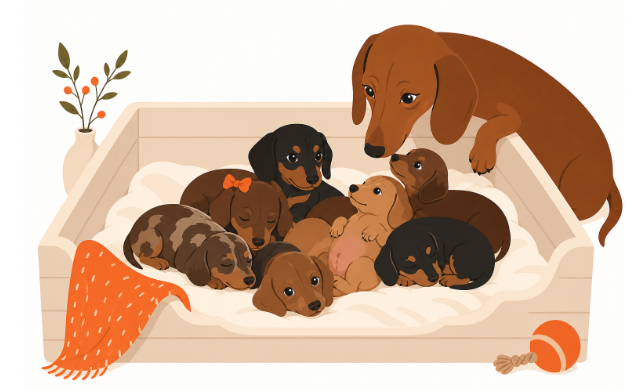
A standard dachshund typically has 4-6 puppies per litter. Miniature dachshunds usually have 3-5. First-time moms on both sides tend to have smaller litters – often just 2-3 pups. Litter size depends on the mother’s age, health, breed size, and genetics. Pregnancy lasts 58-68 days. After birth, the first four weeks are critical: keep puppies warm (85-90°F week one), make sure they nurse within the first hour, and get a vet check in the first week. Mini dachshunds need extra monitoring during birth and are more likely to need a C-section than their standard cousins.
How many puppies does a dachshund have?
On average, dachshunds have between 4 and 6 puppies per litter. But that number can swing quite a bit – anywhere from a solo pup to a litter of 12 is possible. In September 2023, a three-year-old dachshund named Winnie from Leicester, England reportedly gave birth to an astonishing 11 puppies, potentially setting a new record for the breed.
So while 4-6 is your baseline expectation, don’t be surprised if your dog surprises you in either direction.
Standard vs miniature dachshunds
Breed size makes a real difference. Standard dachshunds comfortably average 4-6 puppies, while miniature dachshunds typically land in the 3-5 range. Their smaller frames simply can’t carry as many pups – and this also explains why minis face a higher risk of complications during delivery.
That said, dachshunds have an advantage their compact size doesn’t suggest: their long, elongated bodies actually give them more room to carry puppies than you might expect for a small breed. It’s one of those quirks of the sausage dog anatomy that works in their favour.
How many puppies do mini dachshunds have in their first litter?
If your miniature dachshund is having her first litter, expect 2-4 puppies. First-time moms of any size tend to have smaller litters as their bodies are still learning the ropes. Some Reddit users in the r/Dachshund community have reported first mini litters of just one or two pups – and those single-puppy litters can grow into perfectly healthy dogs that live 16+ years.
What affects the number of puppies?
Several factors determine whether your dachshund’s litter will be on the smaller or larger end:
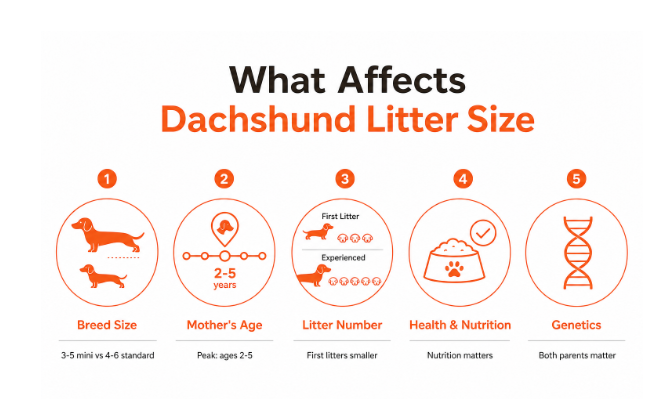
What affects dachshund litter size – infographic showing 5 key factors including breed size, age, litter number, health, and genetics
- Breed sizeThis is the biggest factor. Standard dachshunds (typically 16-32 lbs) have larger litters than miniature dachshunds (under 11 lbs). If you own a tweenie dachshund – one that falls between standard and mini sizes – expect litter sizes somewhere in between.
- Mother’s ageA dachshund in her prime breeding years (roughly 2-5 years old) is most likely to have a larger litter. Younger dogs having their first litter, and older dachshunds (5+ years), tend to have fewer pups. As females age, litter sizes naturally decrease.
- Which litter number it isFirst litters are almost always the smallest. By the second or third pregnancy, most dachshunds will have larger litters as their bodies become more experienced at pregnancy and delivery.
- Health and nutritionA well-fed, healthy dachshund is more capable of carrying a larger litter. Poor nutrition, underlying health problems, or being over- or underweight can all reduce litter size. This is one big reason why pre-breeding vet checks matter so much.
- GeneticsBoth the mother and the father contribute to litter size potential. If a sire consistently fathers larger litters, that matters. Good breeders track this kind of history.
How many litters can a dachshund have in a year?
Technically, a dachshund can have 2-3 litters per year since they go into heat roughly twice a year. But “can” and “should” are very different things here.
Responsible breeders limit their dachshunds to 1-2 litters per year maximum, and most recommend no more than 3-4 litters in a lifetime. Pregnancy, whelping, and nursing take a serious toll on a dog’s body. Dachshund moms lose significant calcium during pregnancy – calcium that needs time to replenish before another pregnancy is safe.
At minimum, leave 12 months between pregnancies. Less than that and you’re risking hormonal imbalances, a weakened immune system, and harder recoveries for mom. It also tends to affect the health and temperament of the puppies.
If you’re not planning to breed at all, spaying your dachshund at 6-8 months of age is generally recommended – it protects her from unwanted litters and significantly reduces the risk of uterine infections and certain cancers.
How to take care of a pregnant dachshund
The good news: most dachshunds handle pregnancy well, and many breeders say the first sign something might be off is simply a more tired or clingy dog in weeks 1-2.
DachshundSpace pregnancy week-by-week guide – showing what to expect at each stage of a dachshund’s pregnancy, as taken from DachshundSpace
Week-by-week pregnancy timeline
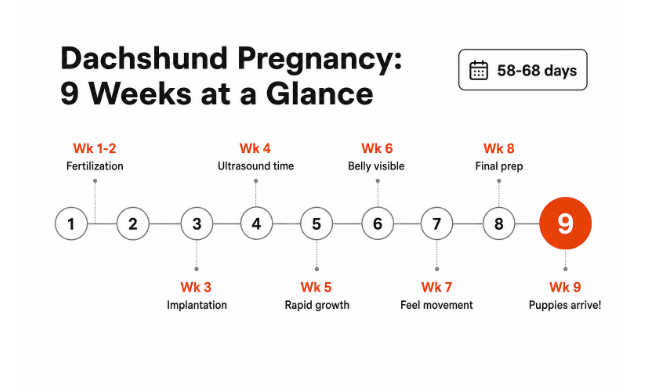
Here’s a simplified breakdown of the dachshund pregnancy week by week:
| Week | What’s happening | What to do |
| 1-2 | Fertilization and early development – no visible signs yet | Keep her routine normal, light exercise only |
| 3 | Embryos implant; she may seem clingier or more tired | Comfortable, low-stress environment |
| 4 | Vet can confirm pregnancy via ultrasound | Book that vet check; discuss dietary adjustments |
| 5 | Fetuses growing fast; belly starts to show | Switch to high-quality puppy or pregnancy food |
| 6 | Rounder belly, nipples enlarging, possible nesting behavior | Set up the whelping box |
| 7 | You may feel puppies moving if you gently touch her belly | Reduce strenuous activity, keep things calm |
| 8 | Final development; puppies positioning for birth | Have vet’s emergency contact ready |
| 9 | Labor! Most deliver around day 63 | Stay calm, watch for signs of distress |
Dachshunds are pregnant for 58 to 68 days, with most delivering around day 63. If your dog passes day 68 without signs of labor, call the vet – don’t wait.
Nutrition during pregnancy
This is where a lot of first-time breeders underestimate the need. From week 5 onward, switch your dachshund to a high-quality puppy food or a food specifically formulated for pregnant/nursing dogs. She’ll need extra calories and a better nutrient profile to support the growing puppies.
Key supplements to discuss with your vet:
- Calcium – dachshunds lose significant calcium to growing puppies. Deficiency can cause eclampsia (milk fever) after birth.
- Folic acid – supports healthy neural development in puppies.
- Omega 3 and Omega 6 fatty acids – support the puppies’ brain and coat development.
Check with your vet on dosing – too much calcium before birth can actually cause problems with uterine contractions, so timing matters. A good starting point is our dachshund feeding chart and the range of health care products designed for dachshunds.
Preparing for birth
By week 6, set up a whelping box in a quiet, warm area of your home. It should be:
- Large enough for mom to stretch out comfortably
- Lined with clean, soft bedding she can nest in
- Positioned away from household traffic and noise
- Easy for you to monitor without hovering
Dachshunds have a strong nesting instinct, and giving her a designated space she can call her own really does reduce stress during labor. Most dachshunds will make it very clear they’ve chosen their spot – and it might not be the box you prepared (my own dachshund once decided the middle of the couch was the perfect delivery room).
Signs labor is starting
Watch for these in the days and hours before delivery:
- Nesting behavior – rearranging blankets, digging, seeking quiet corners
- Refusal to eat – often 12-24 hours before active labor
- Panting or restlessness – even when she’s not hot or active
- Drop in body temperature – below 99°F typically signals labor within 24 hours (you can monitor this with a rectal thermometer)
- Visible contractions – active pushing begins
Can dachshunds give birth naturally?
DachshundSpace guide to natural dachshund birth – covering labor signs, complications, and what to expect, as taken from DachshundSpace
Most dachshunds can give birth naturally, and most deliveries go smoothly without intervention. But their long spines and relatively narrow birth canals do mean complications aren’t rare – especially in miniature dachshunds.
Watch closely if labor is active (visible pushing) for more than 30-60 minutes without a puppy appearing. That’s your signal to call the vet immediately. Dystocia (difficulty giving birth) is a real risk in this breed, and a C-section may be needed – more often with minis than standards.
Between puppies, there’s usually a break of 15-60 minutes. Longer than 2 hours between pups without another delivery is another reason to call the vet.
How to care for newborn dachshund puppies
The first four weeks are both the most demanding and the most rewarding part of the process.
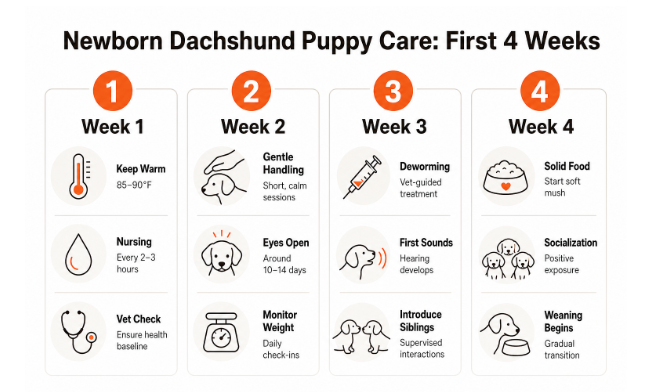
Newborn dachshund puppy care infographic showing week-by-week milestones from week 1 through week 4
Week 1: warmth, nursing, and the vet check
Newborn puppies can’t regulate their own body temperature. Keep the whelping area at 85-90°F (29-32°C) for the first week – use a heating pad on low under one half of the box so puppies can move away from the heat if needed. Never put the heat source directly under all the bedding with no escape route.
The most important thing in the first hour after birth: make sure every puppy nurses. That first milk (colostrum) is packed with maternal antibodies and sets them up for a healthy start. If a puppy is too weak to latch or is being pushed aside by stronger littermates, call your vet – you may need to supplement with puppy milk replacer.
Schedule a vet check within the first 7 days of birth. The vet will confirm all pups are healthy, check for cleft palates or other issues, and give you deworming and vaccination timing.
Week 2: eyes opening and first handling
By the end of week 2, puppies’ eyes begin to open. This is also when you can start daily gentle handling – picking each pup up briefly, letting them feel human hands. This early socialization makes a huge difference to how comfortable they are with people later in life.
Keep handling sessions short (1-2 minutes per pup) and make sure mom is relaxed with you nearby. Some dachshund moms are more protective than others.
Week 3: deworming and sounds
At 2-3 weeks, your vet will typically recommend the first deworming treatment. Intestinal parasites are common in puppies and the treatment is straightforward. First vaccinations can be discussed with your vet around this time too, though the typical schedule starts at 6-8 weeks.
Introduce soft sounds at this stage – quiet music, normal household noise. Puppies exposed to varied sounds early are usually calmer and more confident adult dogs. Our guide on dachshund behavior problems has more on building a well-adjusted dachshund from puppyhood.
Week 4: solid food and weaning
Around the 4-week mark, start introducing soft, mushy puppy food – a quality dry kibble soaked in warm water or mixed with puppy milk replacer until it’s almost a paste. This is the beginning of weaning, which gives mom some relief from nursing and starts teaching puppies to eat independently.
Offer the mush 3-4 times daily in a shallow dish the puppies can access easily. Expect mess. Lots of mess. This is also when they’ll start moving around the whelping area more confidently, tumbling over each other, and discovering their littermates as playmates rather than just competition for the milk bar.
By weeks 6-8, puppies can transition to solid food and are ready to go to their new homes after final vaccinations and vet clearance.
Hygiene and whelping area upkeep
Keep the whelping box clean and dry throughout. Dachshund moms are usually excellent at cleaning their puppies in the early weeks, but you’ll need to swap out soiled bedding regularly as the pups grow and start moving around more. A damp, soiled box is one of the fastest routes to respiratory infections in newborns.
Dachshund Space – for every stage of the journey
Whether you’re preparing for your first litter or already knee-deep in puppy chaos, Dachshund Space has gear and guides built specifically for the breed. From puppy essentials checklists to health care products formulated for dachshunds’ unique anatomy, everything here is made with the sausage dog’s specific needs in mind – including that famously long spine that needs extra support during and after pregnancy.
You can also explore dachshund harnesses designed with the breed’s proportions in mind, which are especially useful during pregnancy when a standard collar can put uncomfortable pressure on a heavily-pregnant dachshund’s neck and back.
Frequently Asked Questions
How many puppies can a dachshund have in their first litter?
First-time dachshund moms usually have 2-3 puppies. Miniature dachshunds having their first litter typically have just 2-4 pups. First litters are almost always smaller because the mother’s body is still adapting to the demands of pregnancy and delivery. Learn more in our full guide on dachshund puppies.
How many puppies do mini dachshunds have?
Miniature dachshunds typically have 3-5 puppies per litter, which is slightly smaller than the 4-6 average for standard dachshunds. Their petite frames simply can’t carry as many pups, and first litters for minis often produce just 2-4. Mini dachshunds also face a higher risk of needing a C-section due to their smaller birth canals. Read more about miniature dachshund facts.
How long are dachshunds pregnant for?
Dachshunds are pregnant for 58 to 68 days, with day 63 being the most common delivery date. That’s roughly 9 weeks from conception to birth. The exact timing can vary slightly depending on the individual dog. Check out our detailed dachshund pregnancy week-by-week guide for a full breakdown of what to expect.
What affects how many puppies a dachshund has?
Several factors influence dachshund litter size: breed size (standard vs miniature), the mother’s age (peak fertility is between 2-5 years), which litter number it is (first litters are smaller), overall health and nutrition, and genetics from both parents. A well-nourished, healthy dachshund in her prime is most likely to have a larger, healthier litter.
How many litters can a dachshund safely have in her lifetime?
Responsible breeders generally limit a dachshund to 3-4 litters maximum in her lifetime, with at least 12 months between pregnancies to allow full recovery. While technically a female dachshund could have more, overbreeding causes serious health problems – including weakened immunity, hormonal imbalances, and complications in future pregnancies. If you’re not planning to breed, spaying at 6-8 months is recommended.
Updated: 07/02/2026






 Dachshund Jackets & Coats
 Dachshund Hoodies
 Dachshund Sweaters
 Dachshund Shirts
 Dachshund Life Jackets
 Dachshund Costumes
 Dachshund Pajamas

 Dachshund Harnesses
 Dachshund Collars


 Dachshund Backpacks


